Peerless Society
The Peerless Society is a dedicated community of enthusiasts committed to the care, preservation, and celebration of the Peerless built automobiles. As one of the most distinguished motorcars in the early part of the 20 century, the Peerless represents the pinnacle of engineering, craftsmanship, and timeless.
Intro
The Peerless Company
Manufacturers Of:
Peerless Wringers;
Peerless Bicycles;
Triangle Bicycles;
Auto Parts for White, Winton, De Dion Bouton starting in 1898;
Peerless Automobiles;
Peerless Trucks;
FWD Trucks;
Carling Red Cap Ale;
Carling Black Label Lager
Introduction
Most histories of Peerless put down 1889 or 1869 as when the company was founded. Re-printing a copy of the company letterhead in the CO-OPERATOR, the Peerless Motor Car Club newsletter, Richard Litchfield proved it was 1865.
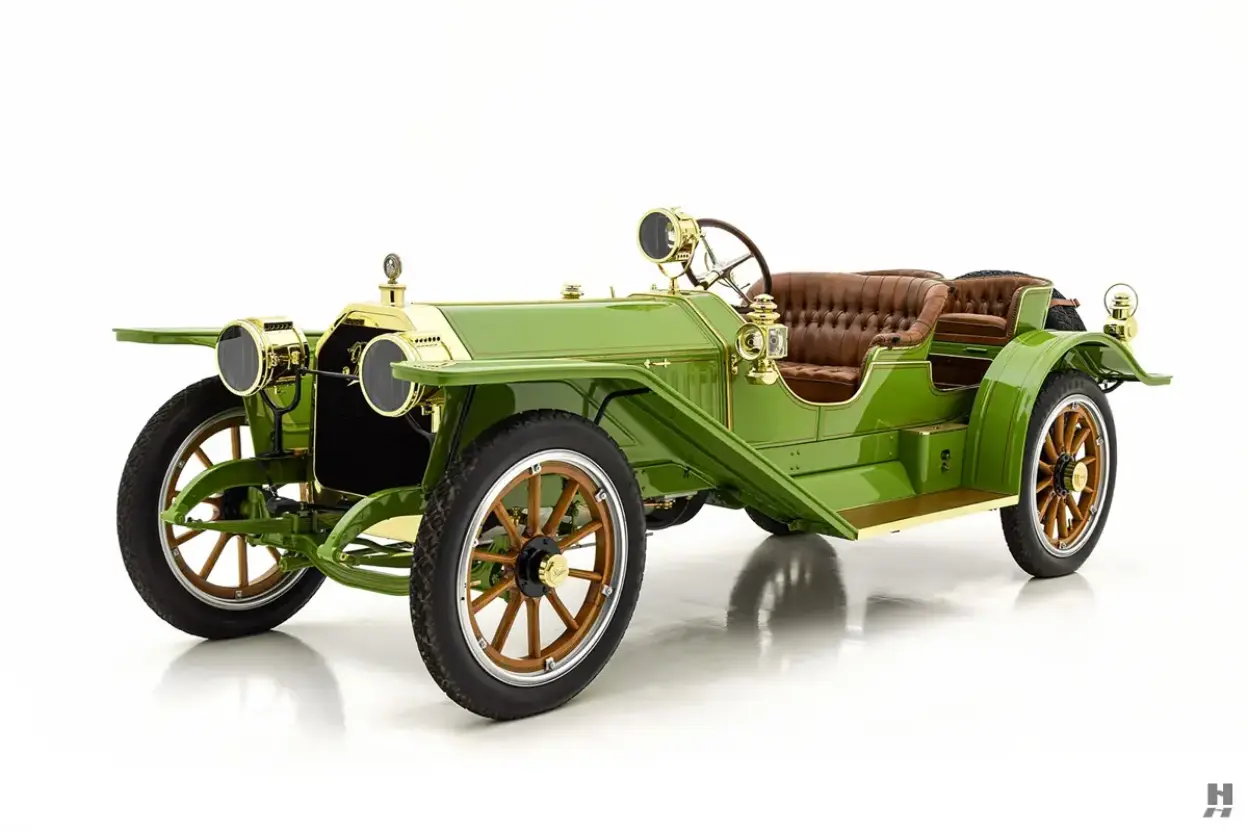
In 1900, the Peerless Motor Car Company began production of a one cylinder, the "Motorette". Prior to 1900 the company had built clothes wringers and bicycles. The Cleveland based company quickly rose to prominence as a premiere car builder and automotive innovator. Peerless was the first company to adopt what would become the standard of automobile design, a front mounted engine driving the rear wheels through a solid drive shaft. This design is still used extensively and until the early 1980's, when American companies began building front engine/front wheel drive cars, was virtually the only design employed by American manufacturers. Driving the rear wheels through chains had been the norm. Production Increases and Racing Begins In 1902 Peerless ordered C-Channel-steel frames from A.O. Smith, 1st carmaker to do so. By 1904, Peerless was building a four cylinder car with the C channel frame. Other manufactures soon followed their lead and C channel frames are still extensively used. Perhaps the most advanced feature of the 1904 model was the tilt steering wheel, which was not adopted until the 1970's by most major manufacturers. In 1904, the company produced a 60 horsepower racer. World famous race car driver Barney Oldfield was hired to drive the "Green Dragon." Oldfield and the Dragon began setting speed records across the country. Peerless built a series of Green Dragons each replacing its predecessor. The Peerless name became famous nationwide and Barney became America's first national sports hero.Racing to Luxury.
By 1906 emphasis was shifted from racing to luxury.
Oldfield and the "Green Dragons" were soon gone. 1,176 cars were built that year and the slogan "All that the name implies" was adopted. By 1907, Peerless had introduced a 6-cylinder model. Large expensive well-appointed motor cars would soon become the trademark of Peerless. It is said 1904, 1909, and 1913 mark the years Peerless was the country's most expensive automobile.
Continued Luxury.
Peerless continued to set the pace in luxury cars. In 1914, Automotive Trade Journal described the interior of the ‘Salon-Sedan’ as follows: "A car with an interior resembling a cozy and luxuriously furnished drawing room...The carefully harmonized and tasteful fittings are imported from European workshops. The interior colors of the car are dark mahogany, ivory, and green, blending from the darker to the lighter shades. Dark green linoleum covers the floor boards and is bound with German silver moulding. The carpet is high-piled English Axminster. At the floor and the sidewalls is a base-board of mahogany about four inches wide. Above this is wool frieze cloth and a chair rail of the same design, only smaller. Around the windows is a veneering of ivory enamel and the sashless panes are set in a veneer of three quarters of an inch wide mahogany. The shades are silk taffeta. The festooned draperies are silk broche lined with silk taffeta. The dome ceiling is lined with plain wool tapestry laid in a panel with flush lights in each of the four corners. Pillows are of Italian brocade with silk tinseled velvet border. A toilet case is of mahogany with fittings of silver and mahogany-colored goat skins. All the interior metal parts are quadruple silver plated. At the rear corners are two disappearing Pullman electric lights for reading. Compartments are furnished for gloves, books, papers and slip covers."
Introduction of the V8.
In 1915, Cadillac introduced a V-8. Peerless not to be out-done, soon followed with its own. Peerless' V-8 was introduced in late 1915 for the 1916 model year (332 Cu. In.). Not the end of Peerless’ automotive innovations, at 1/2-way through 32 years of carmaking, it was more of a new direction. The company’s ownership and management seemed to be in a constant state of flux. While major changes slowed, the Peerless "V-Type Eights" built 1916-1928 were excellent motorcars of high quality. Though experimenting with a V-12, they decided to go "all V-8" (like Cadillac and Lincoln did) for 8 years. The Model "56" V-8 was improved in 7 stages during these 8 years... and again in '23, '25 and '26 with models "66", "8-67", and "8-69".
Introduction of 5 Sixes and 1 Straight Eight in the 1920s.
The company tried to survive on its laurels, but its reputation soon began to slip. By 1924, the company was out of the top end motor car market. The technically advanced V-8 Mod. "66" V-8 was augmented by an inline 6 of 289 Cubic Inches...the "Six-70"... (sometimes called the Collins Six or Superb Six) in January, 1924. The expansion into the Owner-Driven Luxury models {one notch below the chauffer-driven luxury models}, was in league with what Pierce-Arrow and Packard were doing. Sales of the big Packard V-12s declined to the point Peerless outsold Packard in 1922, leading them to offer 6-cylinder models from 1921-1928 which eventually sold well. Pierce's Series "80", sold 1924-1927, was a similar more affordable car, with an L-head engine of about the same displacement and h.p. as the "6-70". The engine used in the 1924 "6-70" was used in 4 models for six years; "6-70", "6-72". "6-90" and "6-91".
Beginning with the 1926 model year, a series of 4 inline sixes and a straight eight produced by Continental Motors of Michigan appeared to expand model offerings from 2 to as many as 5.
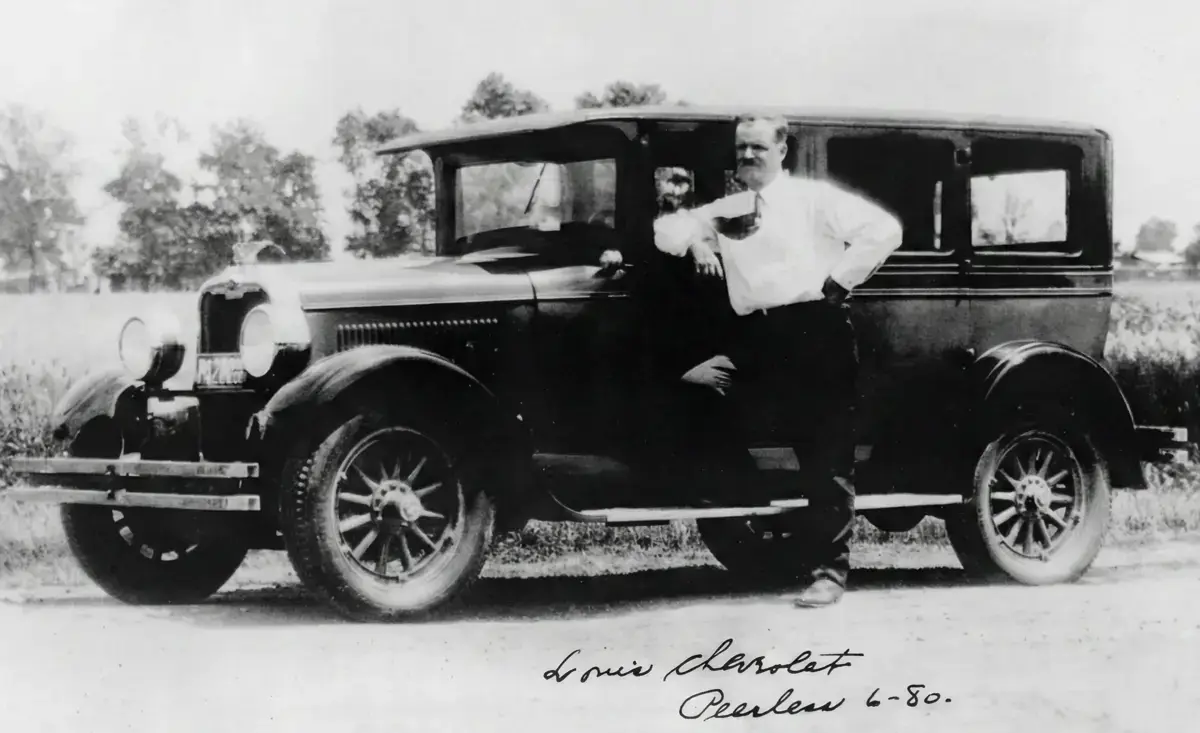
A new slogan was adopted, “Now There’s a Peerless for Everyone.” Did this signal the end of Peerless, or just the end of the premium-luxury-at-any-cost era? Utilizing the Continental engine, the company expanded into the mid-priced field by offering a series of models produced from 1926-1929: "6-80", "6-60", "6-61", and "6-81". The "8-125" was the Peerless top-of-the-line model for 1929 at $2,195-$2,495 and sported a 114 H.P. Continental inline 8.
The Final Years of Automobile Production.
The V-8 was replaced in 1929 by a Continental Straight 8 (322 cu. in.) model, Eight-125. In 1930, three straight-8 models with Continental motors were introduced. The "Standard", "Master", and "Custom" models were all designed by the celebrated Count Alexis de Sakhnoffsky. Peerless made one last ditch effort at survival in 1930. An all aluminum V16 with a body designed by Frank Hershey and built by Murphy. Cadillac and Marmon were the only other car companies to produce a V-16 engine. These multi-cylinder prototypes were designed in conjunction with Alcoa Aluminum: 3 V-16s and 1 V-12. All 4 were driven from Cleveland to Pasadena, CA [with temporary bodies] for new bodies from Murphy. June 30th, 1931 was the end of regular production. The last Peerlesses to come out of the shop were built from leftover parts, ending with "Custom Eight" No. 555 on November 7th, 1931. The client was Cleveland Chief of Police George Matowitz, whose boss was Elliot Ness. Any cars that hadn’t been sold by the end of 1931 were marketed as 1932 models.
Epilogue.
Prior to 1915, Peerless was known for its extreme mechanical precision. Critical mechanical parts were made of extremely durable chrome-nickel steel. The chrome-nickel pistons and rods were weighed and balanced to within hundredths of an ounce. This type of precision today is only available on the most expensive handmade production cars or custom made automobiles. It was the 1st American car builder to have an in-house metallurgy department and for years dyno-tested all their engines. By the late 1920’s the depression had taken its toll on all the luxury car makers. By the mid 1930’s Auburn, Cord, Duesenberg, Franklin, Stutz, Marmon, Locomobile and Pierce-Arrow were all gone from the Auto market. The remainders were Cadillac & Lincoln, who had the sense to be absorbed by bigger firms; Packard, who existed until 1958; and Peerless, who transformed their factory from manufacturing cars to beer between June 30th, 1931 and June 30th, 1933. In 1934, the small print on the label of the Carling Red Cap Ale bottles read: "Wholly owned subsidiary of the Peerless Corporation".
The above essay was inspired by the first Peerless website known, Peerless Motor Car Company: The Greatest Car You've Never Heard Of, by Steve Hennings in 2000. We've edited it so much as to be a different animal, indeed, but Jeff may be the only one reading this who remembers the original site {no longer on the infobahn}. He liked the way the writer grasped some of the high points of the company, particularly the 1914 "60-Six" Salon-Sedan and some illustrations of a bright yellow Peerless Coupe someone in Missouri had 25 years ago (now owned by Peerless Society member Mark M. in New York).